
Sophie Davies takes a tour of some of London’s most colorful street art

Sign Up for Preferred travel’s free newsletter
Vivid Storytelling and Exquisite Stays for the Passionate Traveler
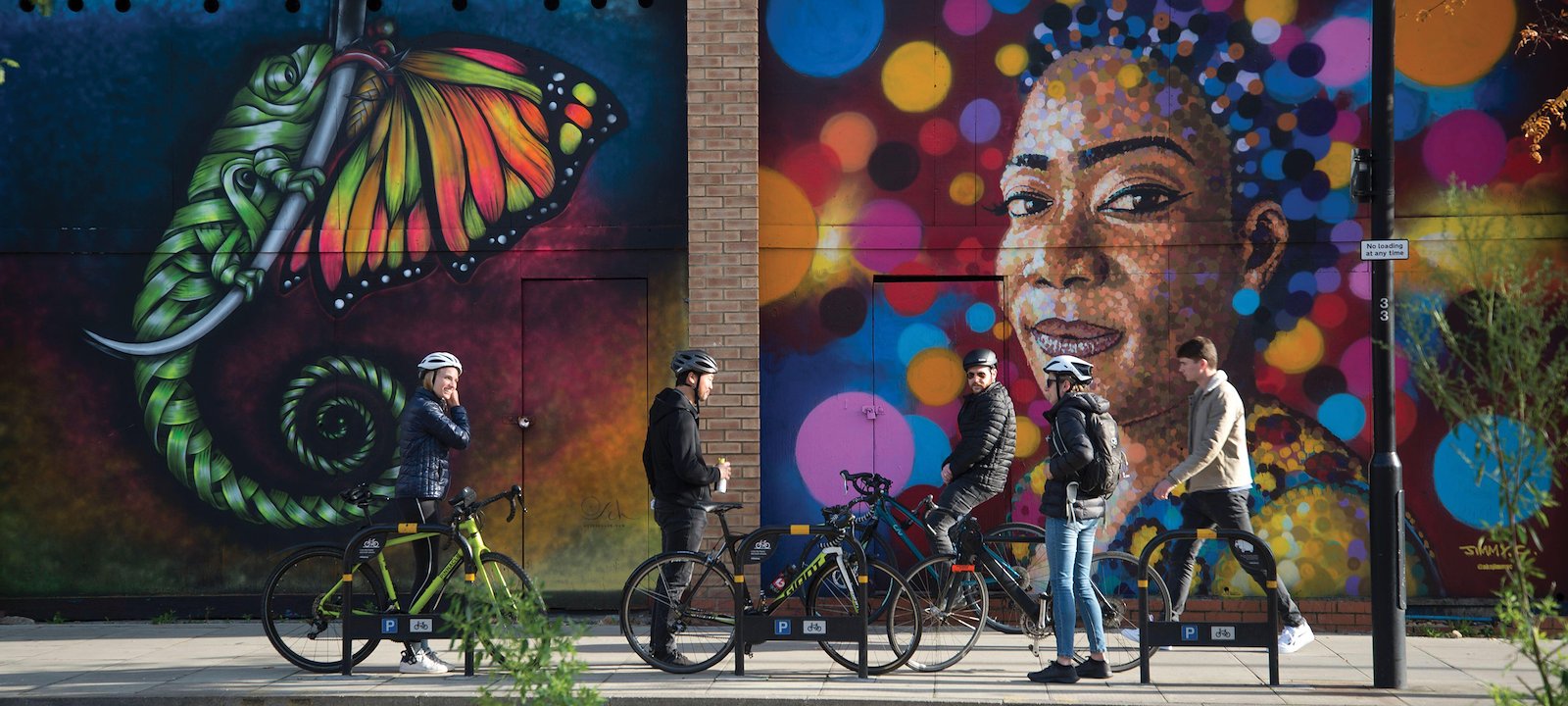
A giant baby towers over the crowd. A monster battles high above. A grinning skull catches your eye. Queen Elizabeth II makes a cameo appearance . . .
Welcome to Leake Street Arches, dubbed “London’s best urban art gallery” and hidden underneath Waterloo Station. Made up of eight former railway arches, adjoining London’s longest legal graffiti wall, it’s a hive of alternative creativity. Floor-to-ceiling artwork brings vibrant color, cartoonish humor, and graphic energy to the dynamic tunnel, constantly evolving as new pieces are painted over old.
Leake Street Artist in Residence Marc Craig was inspired to take up street art in 2014 when he “bumped into Leake Street” on his way home. “As clichéd as it sounds, the moment I stepped into the space my whole life changed,” he says. He uses spray paint with various nozzles to produce his artwork there, which includes three permanent pieces on the ceiling. “I would describe my style as surreal graphical doodles, which then become specific projects,” he explains. “I create my work mainly in Leake Street because I like the democratic nature of the ever-changing walls.”
Homegrown Creativity

London’s street art is world famous, fueled by local talents with groundbreaking skills. It’s also a magnet for international artists keen to leave their mark on the city’s walls, with London’s dramatic clash of ancient and modern streetscapes the perfect canvas for self-expression.
Graffiti pioneered the idea of taking over the streets with spray paint, but street art has evolved into a much more sophisticated art form. In London, you still see examples of “tagging” – the marking of territory on walls and tricky-to-reach bridges and trains with signatures and slogans. By contrast, skillfully produced street art brings stronger aesthetic qualities to bear, and is usually bolder, more attractive, and more engaging. While graffiti remains largely illegal, street art is increasingly painted with permission or even commissioned.
Street art is now used to enhance public spaces, improving the look of derelict buildings, adding intrigue to neighborhoods, and rehabilitating forgotten areas. It’s a recognized method of placemaking for new developments and is used to brand hotels, restaurants, and bars. Embracing everything from spray-painting to stencils, collage, paste-ups, fly posters, mixed media, and massive murals, it plays a key role in urban regeneration, too, bringing empty shops back to life by enhancing retail shutters.
The Pseudonymous Banksy
It’s impossible to talk about the London scene without mentioning British street artist Banksy, the mysterious cult figure whose identity remains a tightly guarded secret.
Rumored to hail from Bristol in the west of England, Banksy’s irreverent, antiestablishment works are humorous, thought-provoking, topical, and highly political. Appearing all over the capital for years, his signature stencils use intricate cutouts to replicate designs on urban surfaces, handy for swift spray-can stealth raids.
He’s best known for images such as “Laugh Now” (a monkey wearing a sign reading Laugh now, but one day we’ll be in charge) and bittersweet “Girl with Balloon” (a young girl whose heart-shaped balloon is floating away). In August 2024, Banksy revealed a menagerie of cheerful animals in odd urban locations around London. His lone wolf on a satellite dish in Peckham was immediately stolen, probably to sell for profit, a frequent occurrence since his works have started commanding millions of dollars at auction.
Banksy has also raised the profile of the street art form globally, taking it from an arrestable offense to a desirable cultural trophy. From 2003 to 2017, Banksy and fellow U.K. artist Eine collaborated to set up Pictures on Walls gallery with a collective of other artists, where they printed and sold their own street art, circumventing the traditional art world. It was a seminal moment, as Eine recalls: “There wasn’t one gallery in London or the world that would touch what we were doing.” Now commercial galleries and auction houses clamor to represent the best creators.
Leake Street’s Arty Origins
In 2008, Banksy transformed a gloomy disused road tunnel near Waterloo Station into a three-day festival celebrating stencil art. Formerly used by taxis servicing the station, the 985-foot-long space was turned into an outdoor art gallery, The Cans Festival, filling it with curated work and attracting the public in droves.
Street artists of all ages climbed ladders to spray their work onto every available inch of concrete. Photographers snapped pictures, curious onlookers peered down from the walkways above, and excited crowds wandered through the twilight world of the tunnel. A painted car was angled up one wall as part of a piece; Elvis Presley, Marilyn Monroe, and Mr. Spock rocked up on the walls and one stencil work caught the mood: “Now we float down the streets we once fell in.”
It’s a great example of the way street art can be harnessed to regenerate disused urban spaces, reclaiming them for social use
An underground sensation, the event permanently established the tunnel as a street art mecca, and its offshoot arches now host live events, bars, and cafés. It’s a great example of the way street art can be harnessed to regenerate disused urban spaces, reclaiming them for social use. The unofficial center of South London’s street art scene, Leake Street is open to all-comers and fosters young talent.
Beyond Leake Street, London is full of renowned places to see street art across an exciting array of neighborhoods, where you can also enjoy local cafés, restaurants, bars, shops, and markets. Marc Craig recommends Shoreditch (start at Brick Lane or Rivington Street) and Hackney Wick in East London, and Camden in North London. In South London, Brixton and Dulwich are also popular.
For an interactive digital map, check out the London Mural Festival. Its September 2024 event showcased more than 100 works by global artists all over the city. Female street artists, including Rosie Woods, Marija Tiurina, and Sophie Mess, were celebrated, and styles ranged from the painterly (Bezt Etam) to monochrome Keith Haring-esque patterns (Mr Doodle), overlapping color (Aches), graphic shapes (Nick Tez), photorealism (Sebas Velasco), and calligraphy (Seb Lester).
Many of the pieces should still be intact, providing a great excuse for a walk around the capital – until the next talent with a spray can arrives to make a fresh statement.